Why Your Supplements Aren’t Working: The Bioavailability Problem Explained

Most people taking supplements every day have no idea how much of what they’re swallowing their body actually absorbs. Supplement bio availability the percentage of a nutrient your body can actually use varies wildly depending on the form, timing, and what you eat it with. A 500 mg magnesium tablet might deliver less than 25mg of actual benefit.
This isn’t a scare tactic. It’s just biology. The journey from that pill hitting your tongue to its ingredients doing their job inside your cells is a lot longer and trickier than most supplement brands let on. And along the way, a lot can go wrong not because you’re doing anything wrong, but because no one explained how this actually works.

What Is Supplement Bioavailability And Why Does It Matter?
“Bioavailability” is just a fancy word for how much of something your body can actually use. A supplement might say it contains 500mg of magnesium, but if your body can only absorb 10–15% of it, you’re effectively getting 50–75mg worth of benefit. The rest exits the building, if you know what we mean.
Not all forms of the same nutrient are created equal. The form a nutrient takes inside the capsule makes a massive difference in how well your body absorbs it.

Magnesium oxide shows up in a huge number of supplements. It has a bioavailability of roughly 4–12%. Magnesium glycinate can reach up to 80% absorption. That’s not a small gap, that’s the difference between a supplement that works and one that’s basically expensive filler. The same pattern plays out with vitamin D (D3 beats D2), zinc, and iron.
Why You Should Take Fat-Soluble Vitamins With Food
Fat-soluble vitamins like A, D, E, and K literally require fat to be absorbed. Your gut wall uses dietary fat as a vehicle to pull these nutrients into the bloodstream. Take a vitamin D capsule with a glass of water on an empty stomach, and a significant chunk passes right through you.

How to Tell If Your Supplement Actually Contains What It Claims
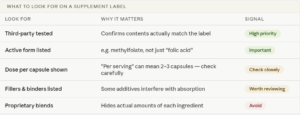
Supplement regulations vary enormously by country. In many markets, a brand does not need to prove their product contains what the label says and third-party lab testing has found that a significant number of products have less than stated, more than stated, or contain things that shouldn’t be there.
Can You Take Too Many Supplements? The “More Is Better” Myth
There’s a common assumption that if some is good, more must be better. With supplements, this is often false and sometimes dangerous. Fat-soluble vitamins accumulate in body tissue. Too much vitamin A over time can cause liver damage. Vitamin D toxicity from over-supplementation is a real and increasingly reported issue.
Even with water-soluble vitamins, the body’s ability to process them isn’t unlimited. B vitamins need cofactors and enzymes to be activated. If you’re flooding your system with B12 but deficient in the co-factors that help convert it, you’re creating expensive waste.
How to Choose Supplements That Actually Work
None of this is meant to make you throw out your supplement cabinet. Most people genuinely need specific nutrients that are difficult to get through diet alone especially vitamin D in sun-limited climates, magnesium in people eating heavily processed diets, and omega-3s in people not regularly eating fatty fish.
The point is to be a smarter consumer. Ask better questions. Read more of the label. And prioritise supplements where someone has actually verified that what’s in the capsule is what the capsule says.
Key Takeaways: Getting the Most from Your Supplements
Bioavailability, which means how much your body absorbs varies wildly by the form of the nutrient, not just the dose.
→ Fat-soluble vitamins (A, D, E, K) must be taken with food that contains fat or you waste most of the dose.
→ Some nutrients compete with each other for absorption. Timing and pairing matter.
→ “Proprietary blends” on labels hide actual amounts almost never in your favour.
→ Third-party testing is the closest thing to a guarantee that a product contains what it claims.
→ More isn’t better. For fat-soluble vitamins especially, more can be harmful over time.
Your body is remarkably good at using what you give it when you give it the right thing, in the right form, at the right time. The supplement industry has made it easy to spend a lot of money without knowing any of this. Now you do.
Home | Vkare | Fuschia | Physiovits | Dr.Snug