How to Repair Your Skin Barrier : Best Vegan Ingredients for Indian Skin
Skin barrier repair is one of the most important and most overlooked steps in any skincare routine. If your skin is reactive, perpetually dry in some patches and oily in others, or simply never settles no matter what you apply, a damaged skin barrier is likely the cause. And for Indian skin dealing with pollution, hard water, and intense UV daily, the barrier is under more stress than most global brands account for.
Everyone’s talking about glowing skin, glass skin, dewy skin. But none of that is possible or sustainable without one thing working properly underneath it all: your skin barrier. And chances are, yours is more compromised than you think.
Here’s the thing most people miss. If you’re layering product after product and your skin is still reactive, the problem probably isn’t your routine. It’s what your routine is being applied on top of. A damaged barrier doesn’t absorb well. It doesn’t protect well. And it definitely doesn’t glow.
Skin barrier repair has become a marketing buzzword, which unfortunately makes it easy to dismiss. But the science underneath it is real, and some of the most effective ingredients for actually rebuilding it come entirely from plants.
What Is the Skin Barrier and Why Does It Get Damaged?
Think of your skin barrier as a brick wall. The skin cells are the bricks. The mortar the stuff holding it all together, is a carefully balanced mix of lipids: ceramides, fatty acids, and cholesterol. When that mortar is healthy, moisture stays in and irritants stay out. When it’s degraded, everything goes wrong at once.
What’s interesting is that a compromised barrier rarely looks the way people expect. It’s not always raw or obviously irritated. More often it’s a chronic low-level wrongness, skin that feels tight after cleansing, reacts to products it used to handle fine, sits oily through the T-zone but flaky everywhere else. That’s not just “sensitive skin” , that’s structural damage.
For anyone living in an Indian city, the barrier is dealing with pressures most global skincare brands were never designed around. Daily PM2.5 pollution settling into the outer skin layer. Hard water stripping natural lipids every single time you wash your face. Humidity throwing off the lipid balance. UV exposure that’s significantly more intense than in the temperate climates where most skincare research happens. The barrier is constantly fighting and for most people, quietly losing ground.
Animal vs. Vegan Skin Barrier Ingredients: What the Science Says
For decades, barrier repair in skincare relied heavily on animal-derived ingredients. Lanolin from sheep’s wool, squalane historically from shark liver oil, cholesterol from animal fat. They work, that’s not in dispute. But they’re not the only option, and for skin that’s already sensitised, they’re increasingly not the smartest one.
Plant-derived versions of the same ingredients like ceramides extracted from rice and wheat, squalane from sugarcane, fatty acids from seed oils, are clinically equivalent in effectiveness. And for reactive, inflammation-prone skin, they tend to be better tolerated. Animal-derived ingredients can carry additional compounds that introduce low-level irritation in sensitive skin. A well-formulated vegan alternative has fewer variables, which matters when the barrier is already compromised and easily tipped.
Best Vegan Ingredients to Repair Your Skin Barrier
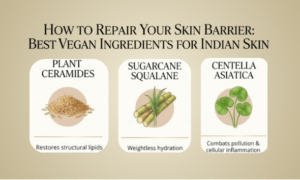
- Plant-Derived Ceramides from rice bran, wheat germ, sweet potato
Ceramides make up roughly 50% of the skin barrier’s lipid content. They’re the mortar. When the barrier is damaged through over-cleansing, pollution, harsh actives, or just ageing ceramide levels fall, and the skin can’t easily manufacture more under stress. They need to come from outside.
What most people don’t know is that plant ceramides, particularly from rice bran, are structurally close enough to the skin’s own ceramides to actually integrate into the barrier and restore function — not just sit on top. This isn’t marketing language. It’s been demonstrated in clinical studies showing measurably reduced water loss and skin sensitivity after consistent use.
Ceramide levels drop by up to 30% in people with eczema and chronic dry skin.
- Sugarcane Squalane — the shark-free version of a genuinely exceptional ingredient
Your skin naturally produces squalane as part of its sebum. It keeps the barrier supple and hydrated. The problem is that production drops sharply from your mid-twenties onward, which is one of the reasons skin gradually becomes drier and less resilient with age, regardless of how much water you drink.
Squalane in skincare used to come from shark liver oil. Now it’s derived from sugarcane and olives, chemically identical, equally effective, and completely vegan. What makes it stand out is how well it mimics the skin’s own lipids: it absorbs cleanly, doesn’t feel greasy, doesn’t clog pores, and works across all skin types including acne-prone. It’s a rare ingredient that genuinely does what it says.
The skin’s own squalane production drops nearly 60% between ages 20 and 40.
- Linoleic Acid — from sunflower, rosehip, hemp seed
This is the one most people haven’t heard of, and it’s worth knowing. Linoleic acid is an omega-6 fatty acid that’s essential for barrier structure. Research consistently shows that acne-prone skin is significantly deficient in it compared to clear skin. When linoleic acid is low, the skin compensates by producing a thicker, stickier form of sebum that blocks pores more easily.
Replenishing it through plant oils that are high in linoleic acid doesn’t add more oil to the skin. It improves the quality of the oil that’s already there, and in doing so, significantly improves barrier function. It’s counterintuitive, but it’s why oily and acne-prone skin often responds well to the right plant oils.
Sebum in acne-prone skin has up to 25% less linoleic acid than clear skin.
- Centella Asiatica
Centella has been used in Ayurvedic and traditional Asian medicine for centuries. Modern research has now worked out exactly why. Its active compounds — asiaticoside, madecassoside, asiatic acid directly stimulate collagen synthesis, reduce inflammation at a cellular level, and accelerate barrier repair after damage.
What’s lesser known is that Centella works on the specific inflammatory pathways that pollution triggers in skin. For anyone in an Indian city absorbing PM2.5 particles daily, this makes it significantly more relevant than just a “soothing” ingredient. It’s actively working against environmental damage at the same molecular level that damage is occurring.
Centella increases collagen synthesis by up to 67% in clinical studies.
- Bakuchiol — plant-based retinol that doesn’t compromise your barrier
Retinol is effective but it’s also harsh. Short-term barrier disruption, purging, peeling, sensitivity for skin that’s already compromised, retinol often makes things considerably worse before they get better. For a lot of people it never becomes worth it.
Bakuchiol, from the babchi plant that’s been used in Ayurveda for generations, has been clinically shown to produce comparable results to retinol, improved fine lines, better pigmentation, firmer skin without the barrier disruption. A 2018 trial compared them directly and found bakuchiol as effective as 0.5% retinol, with significantly less irritation. For reactive skin, this isn’t just the ethical choice. It’s the practical one.
- Oat Beta-Glucan — the anti-inflammatory hiding in your kitchen
Colloidal oatmeal was formally recognised by the US FDA as a skin protectant in 1989 which means the evidence for it predates most of what’s currently being marketed as innovative. Its active compound, beta-glucan, forms a light protective film over the skin, locks in moisture, and this is the part most people don’t know directly communicates with the skin’s immune cells to reduce the overreaction that causes redness, itching, and sensitivity in damaged skin.
Strong clinical evidence across eczema, rosacea, and general sensitivity. Not just one niche condition.
Colloidal oatmeal reduces itching and irritation scores by over 50% in clinical eczema studies.
What Is Damaging Your Skin Barrier? (Common Causes)
Over-cleansing is probably the most common cause nobody talks about. Washing the face more than twice a day or using a heavily foaming cleanser strips the lipids the barrier is built from. The squeaky clean feeling is not a sign of thoroughness. It’s a sign the barrier has been stripped.
Hard water, which is the norm across most Indian cities, leaves mineral deposits on the skin after washing that disrupt pH and gradually erode lipids. People who relocate often notice their skin changing within weeks without changing a single product. It’s almost always the water.
Fragrance including some natural fragrances is one of the most common causes of skin sensitisation and contact reactions. In a damaged barrier, fragrance molecules penetrate deeper than they’re supposed to and provoke immune responses. A product that smells incredible can be actively undoing barrier repair at the same time.
The barrier doesn’t break all at once. It erodes gradually, through accumulated small insults. Repair works the same way.
Why Plant-Based Skincare Is Best for Indian Skin Barrier Repair
The barrier just needs what it’s made of. Lipids, ceramides, fatty acids, anti-inflammatory compounds. Plants have been producing versions of all of these for a very long time and the science has now confirmed, ingredient by ingredient, that they work.
For Indian skin dealing with pollution, hard water, intense UV, and the particular reactivity of melanin-rich skin vegan, plant-derived skincare isn’t a softer alternative to serious skincare. It’s the most compatible and most evidence-backed approach available. Your skin barrier is built from plant-compatible compounds. It follows that plants would be what repairs it best.
Home | Vkare | Fuschia | Physiovits | Dr.Snug